It's a creekmore world

A guide to exotic family travel around the world. (Well some of it, anyway.)
Browsing Camping

The family trip to Mexico, Part two: Camping with kids in the jungle.

November24

We leave the salty sea for the inland jungle on the second leg of our trip to Mexico. Like the first part of our trip, we will continue to see Mayan ruins, but we will also see the cities of Merida and Campeche. The highlight is a camping experience outside the nearly-secret spectacular ruins of Calakmul.

Read the rest of this entry »

Mexico travel planning: Can we backpack with kids in the Yucatan over Christmas?

November12

We bought cheap tickets to the Yucatan a month ago – less that $350 a person for round-trip direct flights. It’s an amazing deal. The Mexican travel industry has been hit hard by swine flu fears and the general economic crisis. We have 15 days over Christmas and New Years to plan out.   Here’s an update:

Planning travel around our kids

This is, of course, family travel.  The girls are very excited, but we have to consider a few things before we depart.
Read the rest of this entry »

Surprisingly good camping and hiking weekend – very close to DC

September20

P1020381

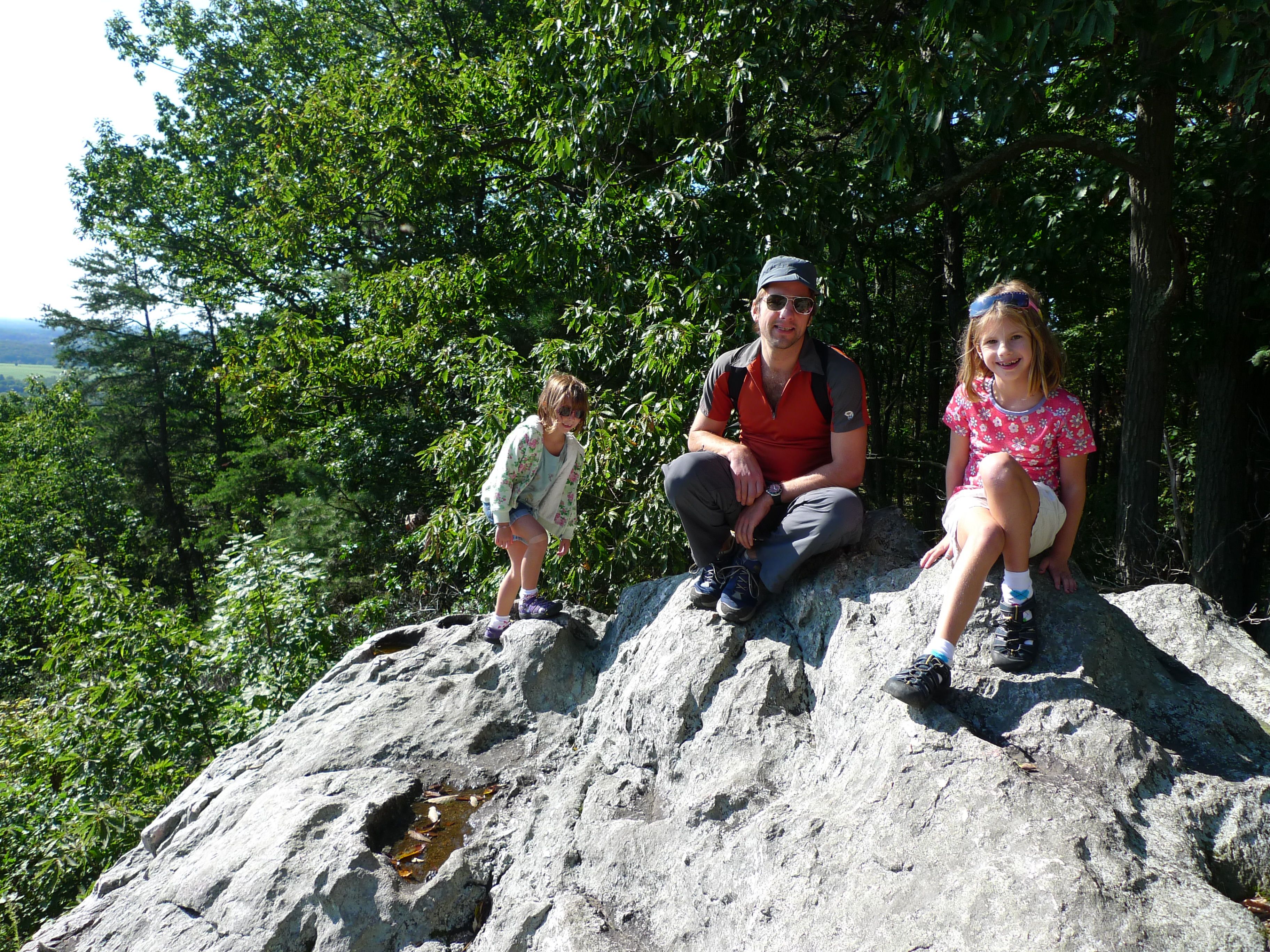
Last week I was looking for (car) camping and a medium-hard hike close to our home in Takoma Park, Maryland outside Washington, D.C.    I found nothing in the Maryland and Virginia State Park online database.  There wasn’t much help when I called.  September is, not surprisingly, a busy season for car campers.   In a desperate moment, I looked for county parks, and found Little Bennett Regional Park in Clarksburg, north of Germantown.   It looked ok on the website, cost $21 a night in advance, and they had plenty of space.  Best of all, it was minutes from  Sugarloaf Mountain – a popular hiking spot.  Despite the rain forecast, I reserved friday and saturday.  The girls were really eager to go camping, so I was willing to try something new.

We left Friday afternoon and bought supplies at the soon-to-be-closed Safeway in Hyattsville.  The car crawled up I-270 in the last vestiges of rush hour but we weren’t in much of a hurry.  The check-in was easy.  They sell, ice, firewood and makings for smores.   The campground had ‘events’ the following day including a 7pm ice cream social!  There are about 40 sites distributed in 5 sections.  We were in Loop C, and it was half-empty.  Like most car campsites that I remember, our neighbors were pretty close, but not so close that you could make out their conversation.

Our site (#46) was only 100 yards from the bathrooms, which are very nice and clean, although I heard someone say the shower water wasn’t hot (no surprise there.)  They had a tent platform that was smooth but still sloped enough to notice when we slept.  There was a picnic table, rusted charcoal grill, large steel firepit and 3 boulders for seats.  Very nice!  The girls and I were alone the first night and we roasted hot dogs, made macaroni and cheese and ate Hershey bars.  Even without daylight, the gear checked-out.  The night temp got to about 45 and we were comfy enough.

Trish joined us early the next day and we made french toast for breakfast before hitting the road.  Our goal was to do an 8 mile hike around Sugarloaf Mountain.    Sugarloaf is a monadnock, a mountain that evolves when the soil surrounding it erodes.  It is, not surprisingly, very rocky. It was purchased privately in the 40′s and is managed by a non-profit called Stronghold that maintains the site and keeps it open for the public.

P1020382

There are three main trails.  The blue and white connect in a figure eight, and together make up the the primary hiking circuit.  The yellow trail is longer and flatter around the base of the mountain and is designed for bikers and horseback riders.   Stright up and down from the summit go three other short trails, green, red and orange.  They are very fun but short.

The summit is only 800 feet above the surrounding exurbia and farmland, so you won’t have trouble getting there.  However, don’t let the low elevation mislead you.  The blue trail goes up and down quite a bit, and we were very winded after our ~7 miles of hiking.  Sugarloaf has just a few panoramic viewpoints along the trail, but it’s fun hiking and it was a spectacular day.  It was somewhat busy – nothing like Billy Goat Trail.

P1020383

Our legs were giving out after 4 hours and we cut the final bit off our hike.  6-7 hour Old Rag hike will be challenging, as will the Amalfi Coast but we have time to build up our capacity.  We piled in the car and the kids fell immediately asleep.  Driving south to Rockville, we had just enough time to see a movie (Ponyo), eat at our favorite local Mexican chain (Guapo’s) and be back to the campsite in time to buy firewood.  (8pm)  We burnt marshmallows on a giant fire and collapsed in sleeping bags before 10 pm.

IMAGE_207

We couldn’t have asked for better weather.  Our gear checked out (mostly).  The girls loved sitting by the fire outdoors.  The hike was memorable and challenging.    The only thing missing was more company.  Come with us next time.

Sahara Desert and M’hamid, Morocco: Day 25

July25

Emma and Lily prepare for the camel trek into the Sahara Desert.We don’t have to drive far today to our next spot, only about 25 miles. It affords us some time to sleep in (til 8 a.m., ha!) and eat a slow breakfast of fresh bread, both baked and a fried kind, like poori. The coffee is made from an Italian stovetop espresso pot and it’s all served in the cute garden.

This hotel has surprisingly good internet access so everyone connects and does some stuff. The girls play ‘Fantage’ and we Facebook and check email. The girls and I film a kid reporter segment in the garden. Back at home, one of their favorite shows is “I Carly” about a tween girl that has a webcast entertainment show. They both love doing the live reporter shtick, but we’ve missed a few days so there is a lot to report.

The road to the Sahara

The road to the Sahara

Piling into the car, we wave goodbye to Muhammad, the manager who struck up a friendship with Lily. Outside Zagora, the road turns to one lane, and fortunately, passing cars and trucks are few. We are back on the path of the Draa River Valley until we get to the place where it finally dries up, a town called M’hamid. As we drive, the desert gets more severe. Gone are any trees. Only low brush can be found here and most of it is white and very dead. We see dunes far off, some as high as 60 feet, although most are lower. Sand blows across the road in swirls. In between the dunes are flat stretches of hard, crackled clay. There are distant mountains to the east and north, but the desert goes to the horizon toward the south and west.

Maison Sahara

Maison Sahara

Our protective 4×4 bubble, fighting to keep the air conditioned, seems inadequate against these elements. I have the same kind of low-level fear that one would have deep under the ocean in a submersible watercraft. What if we break down? What if it leaks? What if we can’t insulate ourselves enough from the elements? It’s not rational, I know. I look out the window and see a boy slowly walking a bike with a flat tire. He’s ok, right? But I’m conditioned to think severe environments like this are hostile. Tonight I will test that conditioning to the extreme. We’re going to hoof it into the desert and sleep exposed under the stars.

Fifty two days by camel to Timbuktu

Fifty-two days by camel to Timbuktu

On the side of the road, we see military building outposts, although most don’t look very active. Not far from here begins the area of border dispute with Algeria that at times includes fighting. Moroccans are fortifying the farthest outposts. Later at night, our guide says that his father used to make the 52-day dromedary ride to Timbuktu from M’hamid. It’s no longer possible because of the military activity in between.

Tamagroute

Tamagroute, Morocco

We’ve passed hundreds of mud-clay Kasbah mini-villages since entering the Draa Valley yesterday and we’ve wanted to see one from the inside. We get our chance at a small place called Tamagroute. Ibrahim pulls right off the road and finds a young boy to lead us through his complex. It’s a few acres and is home to, I would guess, 20-30 families. Each one has a two- or three-room apartment. The one we saw had stairs to a second floor. There is a main ‘street,’ 10 feet wide down the center. I don’t notice any electricity.

Tamagroute

Kids on wall, Tamagroute

It’s surprisingly cool inside, but it’s fairly dark too. Those things go hand in hand in the desert. Lily finds a spot along the back where the mud wall has disintegrated and she scrambles up pretending to be a rock climber. Everywhere we go, the kids ask for money, but our guide shoos them off. At the end he gets a 20 dirham tip ($3) for the tour.

Making pottery in Tamagroute

Making pottery in Tamagroute

Before he goes, he shows us a pottery “factory.” Emma finds it fascinating, not just because clay is fun, but because she sees kids her age at work making handicrafts. I think she is both impressed and surprised. Our young boy guide shows us the process, collecting the clay from deep holes in the ground, spinning the wheel manually, glazing and firing the final product. We buy three bowls for about $20 each. I don’t haggle much, it’s cheap already and these folks are much poorer than the city merchants.

Emma peeks into the Tamagroute mosque. No girls allowed!

Emma peeks into the Tamagroute mosque. No girls allowed!

Just up the road is our next hotel, but we won’t be staying there today. They will keep our bags overnight because we are camping in the desert. It’s much too hot to start the trek in the afternoon, so we eat a slow lunch and take a long three-hour dip in the pool. There is something magical about being under cool water in the desert. The pool is situated in between a pair of caged peacocks, a donkey, pigeons and the camel stable, including a baby. The hotel is deserted except for periodic loud animal noises. Before we leave on Monday, the peacock treats us to a show of his plumage!

Pool time at Chez LaPacha, M'Hamid.

Pool time at Chez LaPacha, M'Hamid, Morocco.

We don’t need towels because we are dried by the steady hot wind in minutes. You have to keep track of your flip-flops because the tile gets so hot that more than a step or two in bare feet will seriously cook your toes. The sun, sand and chlorine dries our skin so much that we all itch. The tops of my feet are getting scaly. Trish digs out a 6oz. bottle of cheap, greasy, moisturizer she kept from one of the hotels and we use the entire thing on our bodies. It helps to stop the itching, but the moisturizer is absorbed instantly, as if we had never applied it.

Trish and I are a little nervous about tonight. Although we have pushed the family pretty far on this trip, we have always been a taxi ride away from comfort. But there is no way to back out once we depart the hotel this evening. It’s an hour-and-a-half dromedary ride to the desert camp, dinner at the campsite, sleep under the stars and return the next morning. It’s simple, but incredibly challenging nonetheless.

Ibrahim and the "camel man" wrap Emma's turban. The turban really works against the sun and wind.

Ibrahim and the camel man wrap Emma's turban. The turban really works against the sun and wind.

At seven, they wrap our heads in blue turbans, which are both functional and fun. The girls look great in their blue djalabas and turbans. We mount, two on a camel, with enough water for the night and depart as the sun sets, led by our guide Ahmed. The Creekmore’s are the only tourists brave (our stupid) enough to do this in July. We have the desert to ourselves.

Heading into the Sahara Desert

Heading into the Sahara Desert

Dromedaries are amazing animals. They were the first thing brought back from Asia five millennia ago, because they are the perfect solution to desert transportation. They can go for six days on stored water and can drink 20 gallons in 10 minutes. With three joints on their legs (there is an extra one just below the hips) they are perfectly suited to carrying stable loads up and down the dunes. They have an extra eyelid for sand and spreading wide feet for the soft sand. North Africa and the middle east would not be the same without them.

But they are not comfortable rides. They lurch around and their backs are arched. You feel every, Every, EVERY bump. After 90 minutes of riding, we all walk around bow-legged. On the worst parts, I’m reduced to painfully wincing and whining, “Ass, Ass, Ass,” in time with the bumpety-bump. Trish’s butt gets bad bruises. Our legs are wobbly when we get off because you have to squeeze them like shock-absorbers the whole way to minimize the damage to your rear-end.

Into the dunes

Into the dunes

However, the desert from 10 feet up is much easier to appreciate. It’s amazing. The long expanses of grey, hard-baked clay with rigid, geometric, cracked designs contrast with the light-brown, swirly, always-changing patterns of the sandy dunes. There are bushes whose roots trap the sand and as the surrounding sand blows away that are left atop small hills appearing to hold on to the earth for dear life.

We see very little life except a few birds and an insect or two on the six-mile trek, although in darkness later, Trish sees something crawling around that looks like a giant white spider or crab the size of a man’s hand. It leaves her mind spooked and her body full of adrenaline. Our guide saw it too and assures us that it’s nothing to be afraid of. Um, sure. No one sits on the ground after that!

Family on dromedaries

Family on dromedaries

Luxor, Egypt at 115 F felt a lot hotter because we were out in the mid-day sun. It’s probably 125 F during the day here, but no one goes out then. It’s a modest 105 F at 7 p.m. when we leave. Maybe we are getting used to it? Anyway, it’s not the heat that makes this area unique, it’s the sand and wind. The wind blows constantly, sometimes gently but often pretty hard. Although the arid wind cools us slightly, it accelerates evaporation of water exponentially. Everyone drinks water at twice or three times the rate of anywhere else on our trip (seven liters in three hours of riding).

The sand is the finest, most granulated sand you have ever felt. It’s finer than the muddy sand at the water line of the ocean. It’s like dust, but it’s really heavy. Even when the wind isn’t blowing, the air is filled with swirling particulate rock. When the wind does blow hard, it’s like being sandblasted. You breathe sand. Your mouth is dry. You crunch on little pieces of grit. Our guide tells us that this is a particularly calm evening and chuckles at us because we still think it’s severe. Yah, we are noobs at this.

Sahara sand rivers

Sahara sand spirits

The sands gets blown by the wind in airborne rivers just above the ground, and it looks like it has a mind of it’s own. The girls think the blowing sand looks like desert spirits coming out for the night.

Just when our butts are about to give out completely, the dromedaries crest a dune and we see the camp off in the distance! We dismount and stagger up a tall, nearby sand dune, perhaps 100 feet high. Ibrahim talks about dunes that are a thousand feet high farther in the desert. Wow. It’s hard to walk, but it feels good to move our legs.

Creekmores rule!

Creekmores rule!

Back at camp, we are all exhausted, nearly falling asleep before they serve dinner. Ibrahim and a local guide, Hamid, come out and sing songs using 10-gallon water jugs as drums. In return, Lily gives them a multi-verse rendition of “Shoo-fly.” The girls tell a few jokes that barely make sense in English, much less translated literally to Arabic. But we are all so tired that we laugh anyway.

Dinner is chicken tagine, which Lily is beginning to enjoy. Emma is stuck with bread again, but she’s a trooper and doesn’t complain. We eat sparely. The climate does weird things to our appetites. After dinner, Trish teaches the girls to pee in the wilderness with a flashlight, causing uncontrollable laughter.

Kid in Sahara

Kid in Sahara

And then we are done for the night, lying four-in -a-row at the edge of the habitable earth, staring up at the night sky. Emma and Lily point out a few simple constellations. Satellites, planets and more stars than we’ve ever seen before are visible from horizon to horizon.

It’s dusty but comfortable on the hard mattresses, elevated off the ground by a short metal platform. It feels exhilarating to be here and the kids excitedly talk. When the chatter finally stops, there is only the total and complete silence of an empty dessert.

I awake in the middle of the night a little cold. The kids need to be rearranged under the short covers for warmth. I throw on my shirt and stare up at the stars again. I can’t help but get a little emotional. We considered this night in the desert to be the apex of our journey, and it’s far better than we imagined. But our month-long trip is coming to a close and every step after tonight is back in the direction of home.

[Photos by Trisha Creekmore]

Archives

Get email updates of our site here.

Enter your email address:

Categories


Get Adobe Flash playerPlugin by wpburn.com wordpress themes